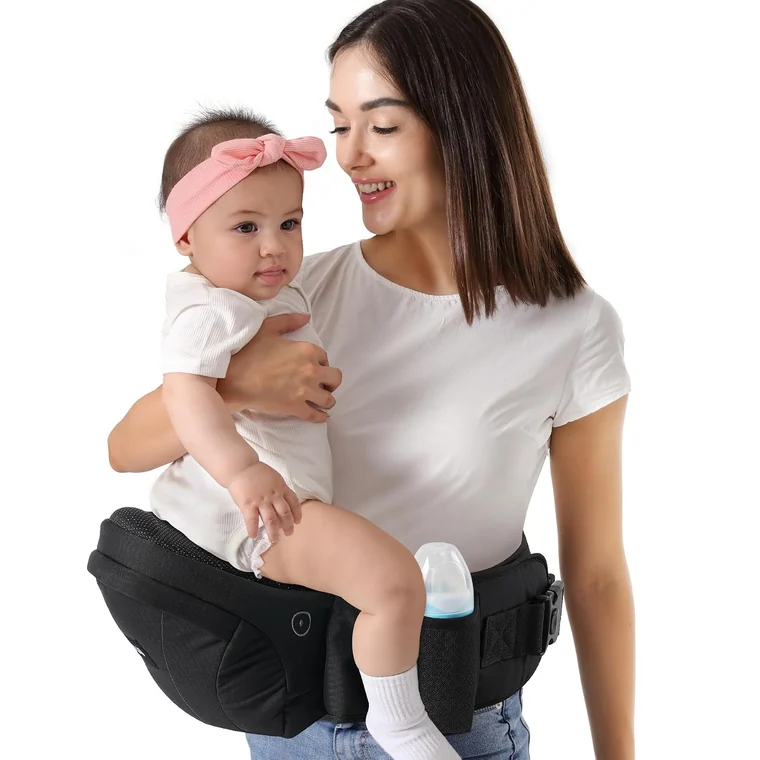
Hip Carrier
Hip seat at 30 degrees, five pockets, under a pound
- Age rangenewborn to 36 months
- Weight limit44 lb
- Black
- Light Grey
A hip seat is the fastest carrier in the house to put on and the easiest one to wear badly. Most of that comes down to where the belt sits.
The belt goes above the hip bones, not around the waistband of your jeans. Pulled tight it sits on bone and the weight goes into your skeleton.
Worn low and loose it hangs off soft tissue, and every pound of the baby pulls on your lower back. That single difference explains most complaints about hip seats, including one of ours.
I picked this up hoping for something easier on my back than holding her on my hip all day, and while it does the job, comfort-wise it wasn't quite what I expected. The waistband, even adjusted, puts a decent amount of pressure on my lower back and hips after extended wear, so it's not something I love using for long outings or errands that take more than 30-45 minutes.The hip…
| Carry | Suits | Watch for |
|---|---|---|
| Facing in | newborn onwards, head supported by you | chin off the chest, face uncovered |
| Hip carry | from about 4 months, once the head is steady | baby leaning into you, not away |
| Facing out | from about 6 months, for short spells | overstimulation, and your own back |
A hip seat is a shelf, not a wrap. It holds the baby's weight but it does not hold the baby: one hand stays on them at all times, whatever the carry.
Hip seats get harder as the child gets heavier, and the change is not gradual. Somewhere around twenty pounds the belt has to be tighter than most people wear it, and a loose belt starts to hurt within half an hour.
Ours is rated to forty four pounds and the fabric handles that. Your back is the part that sets the real limit, and the owners who rated it say so plainly.
Totally worth buying! I am 65 years old and toting around my 3 month old grandson. He doesn’t weigh that much yet, but this thing makes me able to tote him a long time without getting tired. I also have bad knees and this allowed me good stability when moving around and using steps. I was able to put it on and go in about 5 seconds. Definitely worth its price!
The pockets are the reason several owners stop carrying a bag for short trips. Here is what fits, from the reviews and from using it.
| Holds | Reachable while wearing | |
|---|---|---|
| Front main | two nappies and a pack of wipes | yes |
| Side bottle holder | a standard bottle or a small flask | yes |
| Zip side pocket | phone, cards, keys | on the side you do not carry on |
| Mesh side pocket | a dummy, a small toy | yes |
| Inner slip | a folded muslin | not easily |
One owner points out the catch: if you always carry on the same hip, the zip pocket on that side is awkward to reach. Worth deciding which side you carry on before you decide which pocket holds the phone.
The whole thing takes about five seconds once you have done it twice. The velcro is strong, and one owner warns that the back of your hand can catch on it, so pull the strap rather than sweeping your hand across the panel.
Soft carriers sold in the United States fall under a federal safety standard of their own.
Each soft infant and toddler carrier must comply with all applicable provisions of ASTM F2236-24, Standard Consumer Safety Specification for Soft Infant and Toddler Carriers
Electronic Code of Federal Regulations, 16 CFR Part 1226, Safety Standard for Soft Infant and Toddler Carriers. Read 20 September 2026.
The tests behind that specification cover the seams, the buckles and the drop of the seat. None of it removes the need for a hand on the baby, and none of it is a substitute for a belt that is done up properly.
This page is general information about using baby equipment, not medical advice. For anything about your own baby, ask your paediatrician or health visitor.
Hip seat at 30 degrees, five pockets, under a pound